
Many AI initiatives look promising in pilot environments but struggle when they move into production. The model may perform well in testing, but real-world deployment brings a different set of challenges: response speed, infrastructure cost, scalability, reliability, security and governance.
The risk becomes clear when AI moves beyond experimentation. Gartner reports that by the end of 2025, at least 50% of generative AI projects had been abandoned after proof of concept due to poor data quality, inadequate risk controls, escalating costs or unclear business value. This does not mean infrastructure is the only problem. But for teams moving AI into production, the inference platform can strongly influence the cost, speed, reliability and governance needed to scale.
In this 2026 comparison guide, Titan Technology reviews the top AI inference platforms for business across practical criteria such as cost, latency, scalability, governance and enterprise use case. The goal is not to name one universal winner, but to help business leaders understand which platform type best fits their AI roadmap, operating model and long-term priorities.
Comparison Table: Top AI Inference Platforms at a Glance
The best AI inference platform depends on what your business needs to optimize: speed, cost control, scalability, governance, model flexibility or time-to-market. The table below provides a quick comparison of major platforms and provider categories businesses commonly evaluate in 2026.
| AI inference platform | Platform type | Best for | Key strengths | Potential limitations | Best-fit business use case |
| Microsoft Azure AI Foundry | Cloud provider | Enterprises already using the Microsoft ecosystem | Strong enterprise governance, broad model access, integration with Azure infrastructure and security controls | May require cloud architecture planning and Azure expertise | Enterprise AI assistants, internal copilots, regulated workflows and Microsoft-based environments |
| Amazon Bedrock / AWS AI Services | Cloud provider | Cloud-native businesses that need scalable AI infrastructure | Access to multiple foundation models, AWS infrastructure maturity, cross-region options and strong cloud integration | Cost and architecture can become complex at scale without proper monitoring | GenAI applications, enterprise automation, AI-powered software features and cloud-native AI workloads |
| Google Cloud Vertex AI | Cloud provider | Data-driven organizations and teams already using Google Cloud | Strong AI and data integration, support for Gemini models, ML tooling and scalable cloud infrastructure | Best value is often realized when the business already uses Google Cloud or has strong data engineering maturity | AI analytics, data-intensive applications, enterprise search, recommendation systems and AI product development |
| OpenAI API | Foundation model lab | Fast GenAI product development and customer-facing AI features | Strong model capability, developer-friendly APIs, multimodal features and fast experimentation | Token-based costs, data governance and vendor dependency need careful planning at scale | Chatbots, content automation, copilots, customer support tools and rapid GenAI MVPs |
| Anthropic Claude API | Foundation model lab | Enterprise AI assistants and safety-focused use cases | Strong fit for conversational AI, document-heavy workflows, tool use and enterprise assistant experiences | Availability, pricing and model fit should be assessed against specific workload requirements | Internal knowledge assistants, document analysis, compliance-heavy workflows and business productivity tools |
| Hugging Face Inference Providers | Specialist open-source provider | Open-source flexibility and model experimentation | Broad access to open models, provider choice, SDK integration and strong developer ecosystem | Requires stronger technical judgment to select, test and govern models properly | Custom AI workflows, open-source model testing, domain-specific AI applications and model evaluation |
| Replicate | Specialist open-source provider | Fast experimentation with open and community models | Simple cloud API, access to many ready-to-use models, fine-tuning and custom model deployment options | May not be the first choice for strict enterprise governance or highly regulated workloads | Prototyping, creative AI, image/video generation, open-model experiments and early-stage AI features |
Leading AI Inference Platforms to Consider in 2026
There is no single AI inference platform that works best for every business. The right choice depends on your AI use case, existing cloud environment, compliance needs, expected traffic, model strategy and internal engineering capability. Below are several leading platforms businesses commonly evaluate when moving AI workloads from experimentation to production.
1. Microsoft Azure AI Foundry: Best for Enterprise Governance and Microsoft Ecosystem Integration
Microsoft Azure AI Foundry is a strong fit for enterprises already operating within the Microsoft and Azure ecosystem. It allows teams to access models through Azure infrastructure while benefiting from enterprise-grade identity, security, governance and integration capabilities.
For businesses using Microsoft 365, Azure cloud services, Power Platform or existing Microsoft security tools, Azure AI Foundry can reduce operational friction. It is especially relevant for internal copilots, enterprise assistants, document processing workflows and regulated use cases where governance and access control matter.
The main consideration is implementation complexity. Azure can be highly scalable, but businesses still need proper cloud architecture, cost monitoring and integration planning. It is a strong option for organizations that want AI deployment to align closely with existing enterprise IT standards.
2. Amazon Bedrock and AWS AI Services: Best for Cloud-Native Scalability
Amazon Bedrock and AWS AI services are suitable for businesses that already run cloud-native workloads on AWS or need flexible access to multiple foundation models. Bedrock allows companies to build generative AI applications using foundation models through managed AWS infrastructure, while AWS also provides broader services for monitoring, scaling, storage, security and application integration.
This makes AWS a strong fit for AI-powered software products, enterprise automation, customer support tools, recommendation engines and applications that need to scale across regions. For engineering teams already familiar with AWS, the ecosystem can support a more integrated production environment.
The challenge is that architecture and cost management can become complex as AI usage grows. Businesses should plan carefully around workload routing, monitoring, security policies and long-term cost visibility before scaling production workloads.
3. Google Cloud Vertex AI: Best for Data-Driven AI Workloads
Google Cloud Vertex AI, now part of Gemini Enterprise Agent Platform, is well suited for organizations that want to connect AI inference with broader data, analytics and machine learning workflows. It supports access to Google’s generative AI models, including Gemini, while offering tools for building, deploying and managing machine learning and AI applications.
For businesses with data-heavy operations, Vertex AI can be particularly valuable. It fits use cases such as enterprise search, AI analytics, recommendation systems, customer intelligence, document understanding and AI applications that depend on strong data pipelines.
The platform is most effective when the organization already uses Google Cloud or has mature data engineering capabilities. Companies should evaluate whether their existing infrastructure, data governance and technical skills are aligned with Google Cloud before making it the core AI inference environment.
4. OpenAI API: Best for Fast GenAI Product Development
OpenAI API is often a strong choice for teams that need to build and test generative AI features quickly. Its developer-friendly API, strong model capabilities and multimodal support make it useful for chatbots, copilots, content automation, customer support tools, internal assistants and rapid GenAI MVPs.
For businesses that want to move from concept to prototype quickly, OpenAI can reduce the time needed to test user experience, workflow fit and business value. This is especially useful when the priority is speed, quality of output and product experimentation.
However, companies should evaluate long-term production requirements carefully. Token-based costs, data governance, vendor dependency, latency expectations and usage monitoring all become important as adoption grows. OpenAI can be a powerful starting point, but scaling it responsibly requires cost and architecture planning.
5. Anthropic Claude API: Best for Enterprise AI Assistants and Document-Heavy Workflows
Anthropic Claude API is a strong option for businesses building AI assistants, knowledge workflows and document-heavy applications. Claude is often considered for use cases where teams need strong conversational performance, long-form reasoning, document analysis and safer assistant-style interactions.
This makes it relevant for internal knowledge assistants, compliance support, customer service automation, research workflows, contract review, business document analysis and productivity tools. For enterprises concerned about responsible AI behavior, Claude can be part of a safety-focused AI strategy.
The key is to evaluate Claude against the specific workload. Businesses should test response quality, latency, cost, integration requirements and governance fit before committing to large-scale deployment. It may be highly effective for assistant and document use cases, but each deployment still needs structured validation.
6. Hugging Face Inference Providers: Best for Open-Source Flexibility
Hugging Face Inference Providers are useful for businesses that want access to open models and provider flexibility without managing every layer of infrastructure themselves. The platform gives developers access to many machine learning models through different inference providers and integrates with Hugging Face client SDKs.
This is a strong fit for companies experimenting with open-source models, comparing model performance, building domain-specific AI features or avoiding overdependence on a single proprietary model provider. It can also support teams that want more control over model selection and customization.
The trade-off is that open-model flexibility requires stronger technical judgment. Businesses need to evaluate model quality, licensing, security, governance, performance and support readiness. Hugging Face is powerful for teams with capable engineering resources, but it may not be the simplest path for organizations without AI or ML expertise.
7. Replicate: Best for Fast Experimentation with Open and Community Models
Replicate is designed to help teams run AI models through a cloud API without managing infrastructure directly. It is especially useful for fast experimentation with open and community models, including image generation, video generation, creative AI, model testing and early-stage AI product features.
For product teams, Replicate can make experimentation faster because many models are already available to run through API calls. It also supports fine-tuned models and custom model deployment, making it useful for teams exploring AI product ideas before building heavier infrastructure.
However, businesses with strict compliance requirements, complex governance needs or mission-critical production workloads should evaluate carefully. Replicate is valuable for speed and experimentation, but enterprises should assess whether it fits their requirements for reliability, security, monitoring and long-term operational control.
What AI Inference Platforms Mean for Business Outcomes
Choosing an AI inference platform is not just about where a model runs. It affects whether AI can support real users, real workflows and real business demand once the system moves beyond a controlled pilot.
For business leaders, the impact can be seen across four outcomes: cost predictability, user experience, operational scalability and governance. A suitable platform helps the organization control usage costs, maintain consistent response quality, support growing AI adoption and meet security or compliance requirements as workloads expand.
This is why platform selection should be viewed as a business decision, not only a technical one. The right platform gives teams the foundation to move AI from experimentation to sustainable production, while the wrong choice can create cost pressure, performance issues or deployment risks later.
How to Evaluate AI Inference Platforms Before Choosing One
A comparison table can help narrow the field, but choosing the right AI inference platform requires a deeper evaluation. The best option is not always the most popular provider or the platform with the most advanced model. It is the one that fits your use case, operating model, governance requirements and ability to scale AI sustainably.
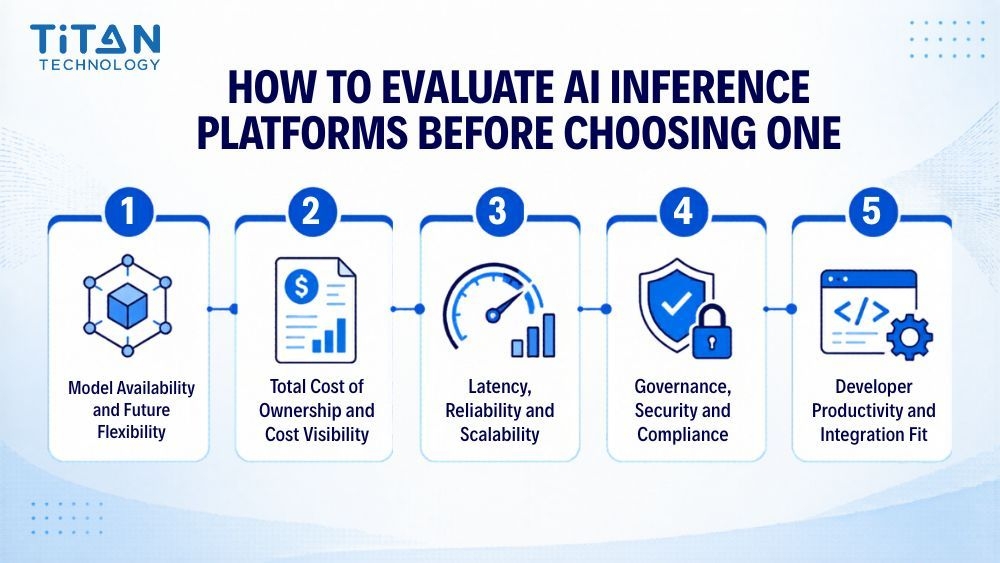
Before making a decision, business and technology leaders should apply five core evaluation filters.
1. Model Availability and Future Flexibility
The first question is whether the platform supports the models your business needs today and the models you may need in the next 12 to 24 months. Some platforms provide access to proprietary foundation models, while others offer broader access to open-weight or specialized models.
This matters because AI strategy can change quickly. A platform that limits model choice may increase switching costs, reduce flexibility and slow innovation. Businesses should evaluate not only current model performance, but also how easily they can adapt as new models, use cases and compliance requirements emerge.
2. Total Cost of Ownership and Cost Visibility
Inference costs grow with usage. Every customer interaction, internal query, document request or automated workflow can add to operating cost. Pricing models vary across platforms, from token-based pricing to compute-based pricing or managed cloud consumption.
Business leaders should look beyond pilot pricing and estimate how costs may evolve under production conditions. Important questions include: How does pricing change with higher traffic? Can workloads be optimized? Are there tools to monitor usage? Which teams, workflows or models are driving inference costs?
A platform that looks affordable during a pilot may become expensive at scale if cost visibility and workload optimization are weak.
3. Latency, Reliability and Scalability
AI applications need to perform consistently. If response times are slow or availability fluctuates, the user experience suffers quickly. This is especially important for customer-facing chatbots, copilots, real-time analytics, recommendation engines and workflow automation.
Businesses should evaluate how each platform performs under peak demand, concurrent usage and multi-region requirements. The platform should be able to support both current traffic and future adoption without forcing the organization to redesign the architecture too early.
4. Governance, Security and Compliance
As AI moves into enterprise workflows, governance becomes a core selection criterion. The platform should support the organization’s requirements for access control, data protection, encryption, monitoring, auditability and compliance.
This is especially important when AI systems interact with customer data, financial records, healthcare information, legal documents or internal knowledge bases. Choosing a platform without the right governance posture can delay deployment, create security risks and reduce trust among internal stakeholders.
5. Developer Productivity and Integration Fit
A strong AI inference platform should help teams move from idea to deployment faster. Clear documentation, intuitive APIs, SDK support, testing tools and integration options can reduce friction for engineering teams.
This matters because AI adoption often depends on iteration speed. Teams need to test models, improve prompts, connect systems, monitor outputs and update features quickly. A platform that improves developer productivity can shorten the path from concept to proof of value and production rollout.
In short, the right AI inference platform should balance immediate speed with long-term control. It should help the business move quickly without creating unnecessary cost, governance or scalability risks later.
Which AI Inference Platform Fits Your Business?
After comparing the major platforms and evaluation criteria, the next step is to identify which type of AI inference platform best fits your organization’s goals. Most businesses evaluate three common categories: cloud providers, foundation model labs and specialist open-source providers.
Each category serves a different purpose. Cloud providers are built for governance, scalability and enterprise integration. Foundation model labs help teams move quickly with advanced AI capabilities through APIs. Specialist open-source providers offer flexibility, customization and greater control over model selection.
The best choice depends on business context rather than technical preference alone. Factors such as internal capability, regulatory obligations, expected traffic, integration needs and long-term AI strategy should guide the decision.
1. When Cloud Providers Are the Best Fit
Cloud providers such as Microsoft Azure, AWS and Google Cloud are well suited for organizations that prioritize stability, governance and long-term scalability. They offer mature infrastructure, enterprise security controls and strong integration with existing systems, making them a natural fit for companies that already operate within a major cloud ecosystem or require strict data management controls.
Cloud platforms are often the strongest choice when an organization plans to adopt AI across multiple departments, connect AI features with internal systems or support mission-critical applications. They provide the operational backbone needed for predictable growth and enterprise-grade reliability.
The main consideration is complexity. These platforms can support AI at scale, but they require proper architecture planning, cost monitoring and cloud expertise to avoid operational overhead.
2. When Foundation Model Labs Make the Most Sense
Foundation model labs such as OpenAI and Anthropic are ideal for teams that need to move quickly. They offer simple APIs, strong model capabilities and rapid setup, which can shorten the time between idea, prototype and initial deployment.
This makes them well suited for early AI pilots, GenAI MVPs, customer-facing features, internal assistants and workflow experiments where speed matters more than deep infrastructure control. Businesses can validate use cases faster before making larger platform or architecture commitments.
However, leaders should monitor cost, latency, governance and vendor dependency as usage expands. These platforms are excellent for early innovation, but larger-scale deployment may require additional planning around cost control, data handling and long-term architecture.
3. When Specialist Open-Source Providers Are the Best Match
Specialist open-source providers such as Hugging Face and Replicate appeal to organizations that want customization and greater control over their AI workflows. They support open-weight models, model experimentation and fine-tuning, giving data and engineering teams more flexibility to build domain-specific AI systems.
These platforms are most suitable for organizations with strong technical capabilities and clear requirements for model control. They can support experimentation, customization and potential cost optimization when managed properly.
The trade-off is operational responsibility. Open-source flexibility requires careful evaluation of model quality, licensing, security, performance and governance. Businesses need the internal capacity to manage and maintain more complex AI operations over time.
Across these options, no single platform type serves every scenario. A company may start with foundation model APIs to move fast, then adopt cloud providers for governance and scale, and later explore open-source platforms for flexibility. Once the business context is clear, selecting an inference platform becomes a strategic decision rather than a technical gamble.
When to Consider Hardware Innovators for AI Inference
Beyond mainstream cloud platforms, foundation model APIs and specialist open-source providers, a smaller group of vendors focuses on specialized hardware and optimized infrastructure for high-performance AI inference. These options are not the default choice for most organizations, but they can offer meaningful advantages when speed, efficiency or scale becomes a competitive differentiator.
For business leaders, the question is not whether specialized infrastructure is more powerful. The better question is whether the organization has a workload that truly requires this level of performance, control and technical investment.
1. Ultra-Low Latency for Real-Time Applications
Some AI applications rely on real-time decision-making where milliseconds matter. Examples include trading systems, conversational agents, fraud detection, autonomous operations and real-time analytics. In these scenarios, slow inference can affect revenue, safety, customer experience or operational performance.
Hardware innovators and optimized inference platforms can help reduce response time by improving how models run on accelerated infrastructure. They are most relevant when latency is a business-critical requirement, not just a technical preference.
2. High-Volume Workloads That Demand Cost Efficiency
Companies generating millions of AI requests may benefit from specialized infrastructure that reduces the cost per request. These solutions are often designed to improve throughput, optimize compute usage and support more efficient model execution.
For businesses with sustained high traffic or tight operating margins, cost efficiency can become a strategic reason to evaluate hardware-focused inference options. However, this should be based on real usage patterns, not assumptions made during an early pilot.
3. Support for Exceptionally Large or Custom Models
Some organizations work with proprietary, very large or heavily customized models that require infrastructure beyond standard deployment options. These workloads may demand more memory, compute capacity, monitoring and optimization than typical API-based setups can provide.
Hardware innovators can support these advanced scenarios, especially for enterprises building deep internal AI capabilities or applying AI to complex scientific, industrial or engineering problems.
4. Not for Most Organizations, but Valuable for the Right Ones
Hardware-focused inference is valuable for the right use case, but it should not be treated as the default path. These platforms typically require deeper engineering investment, stronger infrastructure planning and a higher level of operational maturity.
For many businesses, the smarter path is to start with cloud providers or foundation model APIs, validate business value and understand usage patterns first. Specialized infrastructure becomes relevant when AI capabilities grow and the inference layer becomes a strategic asset rather than a background technical choice.
A Practical Business Framework to Select the Right AI Inference Platform
Once the evaluation criteria are clear, businesses need a structured process to move from comparison to decision. The following framework helps teams avoid vendor driven decisions and focus on practical fit.
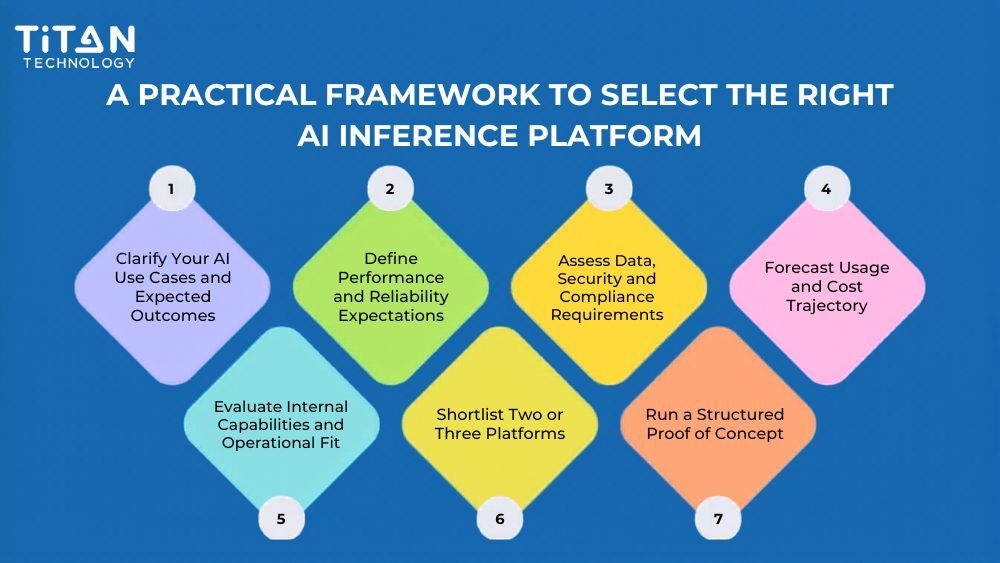
1. Clarify Your AI Use Cases and Expected Outcomes
Start by defining what the AI system is expected to achieve. A chatbot, internal assistant, recommendation engine, document workflow or real time analytics system will place different demands on the inference layer.
2. Define Performance and Reliability Expectations
Set clear expectations for response time, uptime, peak traffic and service consistency. These requirements help teams evaluate whether a platform can support real operating conditions, not only a controlled demo.
3. Assess Data, Security and Compliance Requirements
Map the type of data the AI system will process and identify any security or regulatory constraints early. This helps eliminate platforms that cannot support the organization’s governance standards.
4. Forecast Usage and Cost Trajectory
Estimate likely traffic patterns, model calls, usage spikes and cost growth as adoption expands. This step helps leaders understand whether a pricing model remains sustainable beyond the pilot stage.
5. Evaluate Internal Capabilities and Operational Fit
Assess whether the internal team has the skills to build, monitor, optimize and maintain the selected platform. The right option should match the organization’s engineering capacity and operating model.
6. Shortlist Two or Three Platforms
After applying the key filters, narrow the field to a small number of realistic options. A focused shortlist allows deeper comparison and prevents decision makers from being distracted by too many providers.
7. Run a Structured Proof of Concept
Test the shortlisted platforms under realistic conditions. The proof of concept should validate performance, integration effort, security fit, cost behavior and readiness for production.
A structured selection process reduces the risk of choosing a platform that performs well in a demo but struggles in real operations. It helps businesses make AI infrastructure decisions based on evidence, not assumptions.
How Titan Supports Businesses in Selecting and Deploying AI Inference Platforms
Selecting an AI inference platform is a strategic decision that affects every stage of an organization’s AI journey. It shapes cost structure, performance, scalability and the long-term viability of AI investments. For many businesses, navigating the growing landscape of providers, pricing models and compliance requirements can be difficult without the right technical and strategic guidance.
This is where Titan Technology plays a meaningful role. The team supports enterprises by combining technical expertise with a business-first approach, ensuring that AI adoption aligns with organizational goals and delivers measurable value.
1. Strategic Assessment of AI Readiness and Platform Requirements
Titan Technology begins by helping organizations understand their current capabilities and long-term objectives. This includes evaluating existing systems, identifying potential use cases and clarifying the performance, governance and integration requirements that the inference platform must support.
The result is a clear roadmap that reduces uncertainty during the platform selection process and helps leaders make decisions based on business needs rather than vendor claims alone.
2. Comparison and Evaluation of AI Inference Platforms
The team analyzes the strengths and limitations of cloud providers, foundation model labs and specialist open-source platforms through the lens of each business case. By mapping each option to use cases, cost projections and operational expectations, Titan Technology helps leaders narrow their choices to platforms that fit both immediate priorities and future growth.
This ensures the selection process is guided by practical requirements such as cost control, latency, scalability, governance and integration fit.
3. Architecture Design and Integration Support
Once a platform is selected, Titan Technology designs inference architectures that support reliable performance, predictable spending and seamless integration with existing applications. This includes considerations such as request routing, data handling, monitoring, access control and scaling.
The goal is to create an environment where AI features operate smoothly in production and can expand without unnecessary friction.
4. Implementation, Testing and Optimization
Titan Technology guides organizations through the full implementation process, from initial configuration to production deployment. During this phase, the team validates performance through benchmarking, load testing and real-world usage scenarios.
The team also helps optimize inference workloads to control cost while maintaining the level of performance required for customer and employee interactions.
5. Long-Term Support and Continuous Improvement
AI systems evolve, and so do the platforms that power them. Titan Technology provides ongoing support to monitor performance, refine cost efficiency and adapt architectures to new use cases as the business expands.
This ensures that AI remains a scalable and sustainable capability rather than a one-time initiative.
Across these stages, the objective is consistent: helping organizations adopt AI in a responsible, cost-effective and long-term success-oriented manner. For a closer look at Titan Technology’s AI, cloud and software development capabilities, explore the services page or contact the team to begin the conversation.
Conclusion
Selecting an AI inference platform is more than a technical choice. It is a strategic decision that influences how efficiently an organization can scale AI, manage costs, maintain performance and govern production workloads over time. Because every business has different requirements and levels of readiness, there is no single platform that fits all scenarios.
A structured evaluation process helps leaders compare platform options with confidence and avoid short-term decisions that create long-term operational constraints. Our team supports organizations through this process by assessing their needs, comparing platform options and designing architectures that balance performance, cost and governance.
If your business is exploring how to operationalize AI or planning for the next stage of deployment, we are ready to assist. You can explore our AI solutions or reach out to us through our contact page to begin the conversation.
A thoughtful platform choice creates the foundation for scalable and resilient AI capabilities. With the right comparison framework and implementation guidance, your organization can build solutions that grow in line with your ambitions and deliver lasting impact.